
Blog · Emotions & release
The Three Phases of Every Emotion
Why the emotions we hold on to never leave, and how to let them finish their journey.
The weight you carry home
It is Thursday evening. The week is almost done, but something is not. The comment in Monday's meeting. The deadline that moved. The conversation you replayed in the shower. None of it has left you. It has simply been put somewhere.
Most of us are very good at putting emotions somewhere. We swallow them so we can keep working. We explain them away. We tell ourselves a story about them and move on. Then we wonder why we feel heavy, tired or on edge for no clear reason.
The reason is simple. Those emotions were never allowed to finish. To understand what finishing means, we need to look far beyond ourselves, to the way everything in existence moves.
Everything that exists moves through three phases
Observe anything in creation long enough and you will see the same pattern. It is born. It grows. It dissolves.
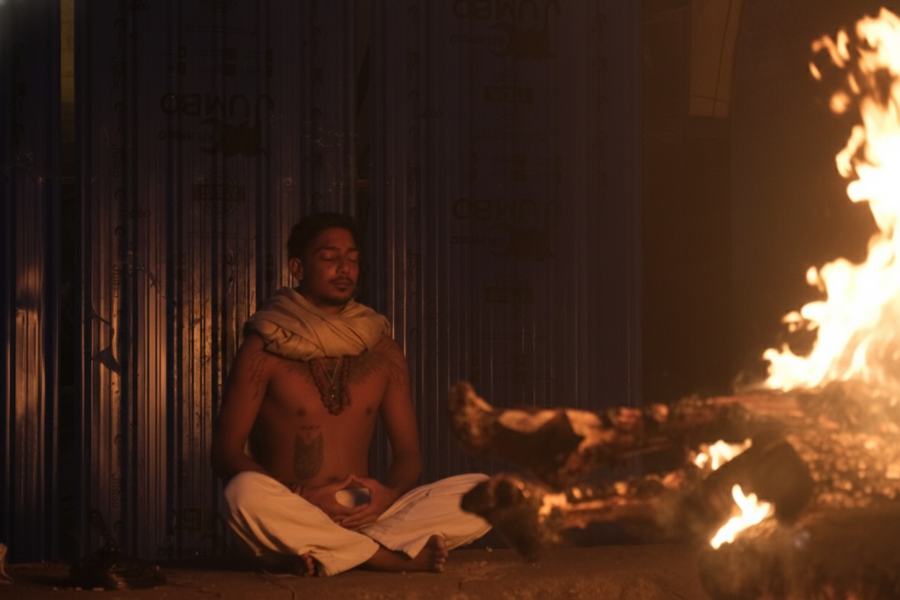
A star is formed from gathering gas and dust. It burns and expands for billions of years. Then it collapses and returns its matter to space, where new stars are born. A tree begins as a seed, grows towards the light, and one day falls back into the soil that feeds the next forest. Even energy follows this rhythm: it rises, it peaks, and it returns to rest.
- Creation: something comes into being.
- Preservation, or expansion: it grows and is sustained until it reaches its fullest expression.
- Dissolution: it transforms and returns to the source it came from.
Nothing in nature skips a phase. Nothing stays in expansion forever. Dissolution is not a failure or a loss. It is completion. Now apply this same law to the emotions moving through you.
How an emotion is created: white light becomes colour
Imagine all of existence as one vast field of energy. Some call it God, Source or Shiva. Others simply call it energy. Picture it as pure white light: whole, undivided and at rest. Pass white light through a prism and it splits into a rainbow. Each colour is the same light, vibrating at a different frequency.
An emotion is born the same way. Something happens and energy spikes in response. On its own, that spike is neutral. It is just energy moving. Then the mind steps in and attaches a story to it:
- "They don't respect me."
- "I'm not good enough."
- "This always happens to me."
The moment the story attaches, the energy takes on a colour. Red might carry anger. Orange might carry suppression, the feeling we push down to stay in control. Each colour is a piece of the white light that has separated from the whole and been given a name.
This is the creation phase. On its own, there is nothing wrong with it. Emotions are part of being human. The problem begins when we never let them move on.
The loop that keeps us stuck
Like every star and every tree, an emotion wants to expand. It wants to be felt, all the way to its peak. This is the preservation phase, and it is exactly where most of us stop.
We stop for understandable reasons. What if it overwhelms me? What if the anxiety hits and I can't function? I still have work to do. So we hold the feeling back. Or we keep feeding it with new stories, replaying the conversation, building the case, adding more colour to the light.
The emotion never reaches its peak, so it never falls back to rest. It stays caught between creation and partial expansion, growing quietly as more energy is converted into story.
Eventually the pressure becomes too much and it bursts out at a moment we did not choose. It might surface as a sudden wave of anxiety, an outburst, or a crash of exhaustion. That burst seems to prove what we feared: emotions will impair me. So we hold on even tighter, and the loop begins again.
The way out is not more control. It is allowing the emotion to complete its natural cycle.
Dissolution: returning to white light
In physics, when an electron absorbs energy it jumps to a higher energy state. It cannot stay there. It releases that energy and falls back to its resting state.
This is a metaphor, not a scientific claim about emotions, but it captures something we can each feel. An emotion that is allowed to rise all the way, felt fully without judgement and without trying to control it, reaches its peak. Then, like everything else in existence, it begins to fall away.
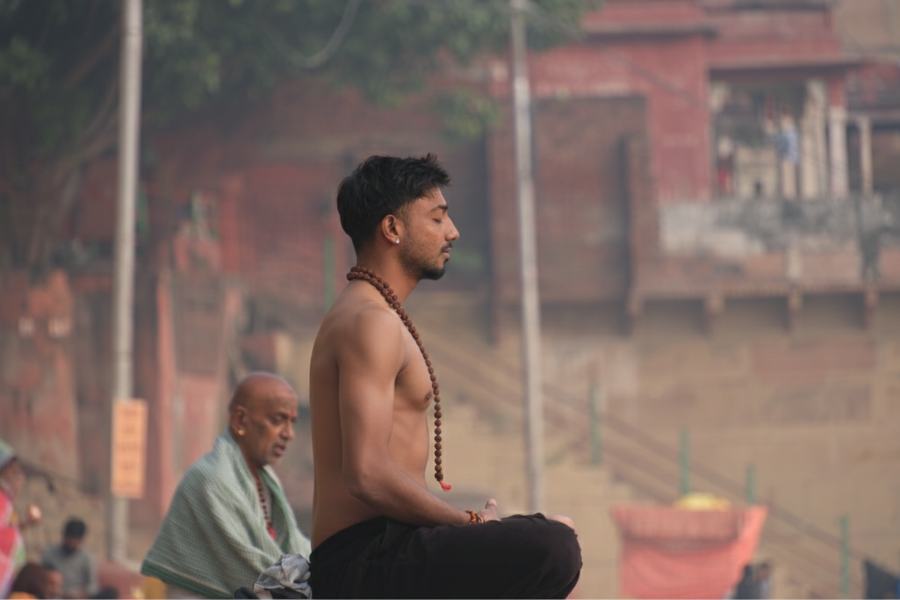
What remains is rest. The colour returns to white light. The energy that was locked in a story becomes available again. People often describe it as feeling clearer, softer, more spacious, as though something has been set down.
The ancient lens: Shiva's five acts
This pattern is not new. In Kashmir Shaivism, all of existence is the play of Shiva, pure consciousness, through five cosmic acts called the pañcakṛtya (पञ्चकृत्य: pañca, five; kṛtya, acts).
- सृष्टि
sṛṣṭi
SRISH-ti · emission, creation
In an emotion: energy spikes and takes form.
- स्थिति
sthiti
STHI-ti · standing, maintenance
In an emotion: it is held and sustained.
- संहार
saṃhāra
sam-HAA-ra · sam, together + hāra, taking back: withdrawal
In an emotion: it dissolves back into rest.
- तिरोधान
tirodhāna
ti-ro-DHAA-na · tiras, hidden + dhāna, placing: concealment
In an emotion: the stories that veil the white light.
- अनुग्रह
anugraha
a-nu-GRA-ha · anu, towards + graha, grasping: grace
In an emotion: clear seeing that lets the colour return to white.
The first three are the cycle every star and tree follows. The last two explain why we get stuck. Tirodhāna is the forgetting: the stories that keep us in separation. Anugraha is the remembering: the moment we see an emotion clearly and stop feeding it, so it can complete its return.
In the language of the Projector Theory, the stories are the reel and the white light is the lightbox. We do not need to fight the movie on the screen. We only need to let the frame finish passing through the light.
The Emotional Release practice
The Emotional Release practice is a guided meditation designed to help emotions complete their full cycle, both feelings stored from the past and new ones created during the week. It rests on one principle: you do not need to fix an emotion. You need to let it finish.
- Arriving. Settling the body and breath so the nervous system feels safe enough to soften.
- Noticing. Gently locating where an emotion lives in the body, without needing to name or explain it.
- Dropping the story. Letting go of the narrative and staying with the raw sensation, the colour itself.
- Allowing the peak. With calm, steady guidance, letting the feeling rise as far as it wants to go.
- Returning to rest. Resting in the stillness that remains, then grounding fully before the session closes.
The calm structure matters. The fear of being overwhelmed is exactly what keeps most emotions stuck. Guidance gives you a safe container, so you can let go knowing you will be brought back to ground.
A two-minute practice to try now
- Close your eyes and take three slow breaths.
- Ask: what am I still carrying today? Notice where it sits in your body.
- Let go of the story about it. Feel only the sensation.
- Let it grow if it wants to. Breathe with it, without pushing it away.
- When it softens, rest in the stillness for a few breaths before opening your eyes.
If something feels too big to meet alone, stop, ground yourself through your feet and breath, and reach out for support.
Begin the return
Every emotion you have ever felt was white light first. It still wants to go home. Your only task is to stop holding the door shut.
Meditation: Inner Completeness
A 4-month meditation immersion, in a group or one-to-one, including the emotional release practice. From S$150 / month.
Explore the programmeThe Inner Ledger
Meditation on Mondays, emotional release on Thursdays, at lunchtime, all year. Founding Partner places open.
Corporate WellnessThis practice supports emotional wellbeing and personal growth. It is not therapy or medical treatment and does not replace professional care. If you are living with trauma or a mental health condition, please speak with a qualified professional before or alongside this work.