
Blog · Timeless Teachings · Shaiva traditions
Who Are the Aghoris? The Word, the Cremation Ground and the Truth Behind the Myths
"An Aghori is more sacred than almost anyone, because in the very place where we said God cannot be found, he realised God."
Aghoris don't do what is taboo to stand out. They do it to show that God is everything: the filth, the waste, and also what you see as clean.
The internet knows the Aghoris as the "cannibal monks of Varanasi". Their own name says something very different. It means "not terrible".
A name that answers the documentaries
Search for Aghoris and you will find the same images again and again: ash-covered men on the burning ghats of Varanasi, skull bowls, rumours of corpses and flesh. Travel shows love them. The camera arrives, films the strangest thing it can find, and leaves.
What the camera rarely stays for is the word itself. Aghora (अघोर) is Sanskrit. It is made of a-, "not", and ghora, "terrible, frightening". An Aghori is a follower of aghora: the one who is "not terrible", or in the way the tradition explains it, the one who has gone beyond what we find terrible.
This article starts where the word starts, in two of the oldest texts of the Shaiva tradition, and then looks honestly at who the Aghoris were, who they are now, and what the sensational stories leave out.
The Aghori does not worship the terrible. He looks at it until it stops being terrible.
About this article
- Tradition: Aghor, an ascetic Shaiva path devoted to Shiva in his fierce and gentle forms. Its best-known lineage looks to Baba Kinaram of Varanasi as its founding saint.
- Language: Sanskrit for the two source texts below, written in Devanagari. The living tradition mostly teaches in Hindi and Bhojpuri.
- Texts used here: the Śvetāśvatara Upaniṣad (3.5) and the Aghora mantra from the Taittirīya Āraṇyaka of the Black Yajurveda, also known as the Mahānārāyaṇa Upaniṣad. Both are public Vedic texts, recited openly, not initiatory mantras.
- History and present day: drawn from the anthropologist Ron Barrett's fieldwork with the Kinaram Aghor lineage in Varanasi, Jonathan Parry's study of death in Banaras and David Lorenzen's history of the medieval skull-bearing ascetics. Full list at the end.
How to read the texts
Each text has the Devanagari, a transliteration (IAST), and a simple guide to how it sounds (capitals show where the weight falls). Open Word by word for the meaning of each word. The translation follows the Sanskrit closely and adds nothing.
1. The gentle body of Rudra
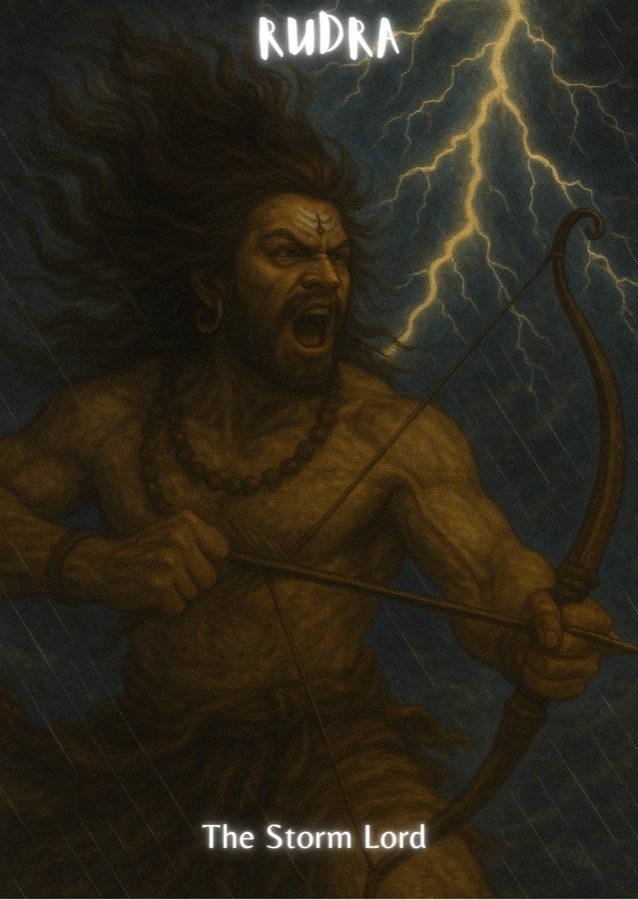
The word aghora first matters in a prayer to Rudra, the storm-god form of Shiva whose arrows were feared. The Śvetāśvatara Upaniṣad, one of the great Upanishads, asks him to turn towards us in his other body, the one that is not terrible.
Śvetāśvatara Upaniṣad 3.5
या ते रुद्र शिवा तनूरघोराऽपापकाशिनी ।
तया नस्तनुवा शन्तमया गिरिशन्ताभिचाकशीहि ॥
yā te rudra śivā tanūr aghorā'pāpakāśinī
tayā nas tanuvā śantamayā giriśantābhicākaśīhi
How to say it
YAA tay RU-dra SHI-vaa ta-NOOR a-GHO-raa-paa-pa-KAA-shi-nee
ta-YAA nas ta-nu-VAA shan-ta-ma-YAA gi-ri-SHAN-taa-bhi-CHAA-ka-shee-hee
Word by word
- yā
- which, that (form)
- te
- your
- rudra
- O Rudra, the fierce form of Shiva
- śivā
- auspicious, kind (the same root as the name Shiva)
- tanūḥ
- body, form
- aghorā
- not terrible, not frightening
- apāpa-kāśinī
- shining without evil, revealing nothing harmful
- tayā
- with that
- naḥ
- us
- tanuvā
- with (that) body
- śantamayā
- most peaceful, most gracious
- giriśanta
- O you who bring peace from the mountain (a name of Rudra)
- abhicākaśīhi
- look upon (us), shine upon (us)
TranslationO Rudra, with that body of yours which is auspicious, not terrible, shining with no evil: with that most peaceful body, O you who bring peace from the mountain, look upon us.
The same verse appears in the Śukla Yajurveda (Vājasaneyi Saṃhitā 16.2), at the start of the hymn to Rudra. Apāpa-kāśinī is read by some commentators as "revealing no sin", by others as "shining without harm".
Here aghora is the opposite of what the documentaries suggest. It is Rudra's kind face. The prayer does not deny that Rudra is fierce. It asks the fierce one to show the side of himself that heals.
2. The Aghora mantra: beyond the terrible
In later Shaiva teaching, Shiva has five faces, each with its own mantra, called the Pañcabrahma ("five Brahman") mantras. Aghora is the southern face, linked with fire and with the power that dissolves and renews. Its mantra comes from the Taittirīya Āraṇyaka and is recited openly in temples and homes to this day.
The Aghora mantra · Taittirīya Āraṇyaka, Book 10 (Mahānārāyaṇa Upaniṣad)
अघोरेभ्योऽथ घोरेभ्यो घोरघोरतरेभ्यः ।
सर्वेभ्यः सर्वशर्वेभ्यो नमस्ते अस्तु रुद्ररूपेभ्यः ॥
aghorebhyo'tha ghorebhyo ghora-ghoratarebhyaḥ
sarvebhyaḥ sarva-śarvebhyo namas te astu rudra-rūpebhyaḥ
How to say it
a-GHO-reb-hyo-tha GHO-reb-hyo GHO-ra-gho-ra-TA-reb-hya-ha
SAR-veb-hya-ha SAR-va-SHAR-veb-hyo na-MAS-te AS-tu RU-dra-ROO-peb-hya-ha
Word by word
- aghorebhyaḥ
- to the forms that are not terrible
- atha
- and also, and then
- ghorebhyaḥ
- to the forms that are terrible
- ghora-ghoratarebhyaḥ
- to the forms more terrible than the terrible
- sarvebhyaḥ
- to all of them
- sarva-śarvebhyaḥ
- to all the forms of Śarva (Śarva, "the archer", is a name of Rudra)
- namaḥ
- salutation, bowing
- te astu
- be to you
- rudra-rūpebhyaḥ
- to the forms of Rudra
TranslationTo those forms that are not terrible, and to those that are terrible, and to those more terrible than the terrible; to all, to every form of Śarva: may my salutation be to you, to all the forms of Rudra.
The section numbering differs between editions of the Mahānārāyaṇa Upaniṣad (it is given as 19.1 in one common edition). The words are the same.
Notice what the mantra does. It refuses to bow only to the pleasant face of God. It bows to the gentle forms, then the terrible ones, then the most terrible of all, and calls them all Rudra. That one line is close to the whole Aghor path: there is nothing in existence that is outside the divine, so there is nothing that must be feared or hated.
Who the Aghoris are
Older roots
Skull-carrying Shaiva ascetics are described in Indian texts from more than a thousand years ago. The best known were the Kāpālikas ("skull-bearers"), studied by the historian David Lorenzen. Aghoris are often called their heirs, but historians are careful here: the line between them can't be traced document by document. What is clear is that Aghori-type ascetics have been part of North Indian religious life for centuries.
Baba Kinaram
The living Aghor tradition of Varanasi looks to Baba Kinaram, a saint of the 17th and 18th centuries (traditional dates vary), who learned from the ascetic Baba Kalu Ram and set up his dhuni, his sacred fire, at Krim Kund in Varanasi. The lineage reveres Dattatreya, the sage-form of the divine, as its first teacher. Kinaram's books, such as the Rām Gītā and the Gītāvalī, are poems of devotion and discernment written in Hindi, not manuals of shock.
The cremation ground
The classic place of Aghor practice is the śmaśāna, the cremation ground. In Varanasi, where bodies burn day and night at Manikarnika and Harishchandra ghats, death is not hidden behind hospital walls. Aghoris meditate there, smear themselves with the ash of the pyres, and eat and drink from skull bowls. The point is not horror for its own sake. It is to face, in the body, the two things we spend our lives avoiding: death and disgust.
A clinic in place of the cremation ground
Here is the part the documentaries usually skip. In the 20th century, Aghoreshwar Bhagwan Ram (1937–1992) turned much of the tradition towards service. Its ashrams in Varanasi became known for caring for people with leprosy, often people whose own families had abandoned them, combining Ayurvedic medicine, ritual bathing and modern biomedicine. The anthropologist Ron Barrett, who studied the work for years, put it simply: the leprosy clinic "has taken the place of the cremation grounds". The Aghori now faces the fear of disease, and the stigma around it, rather than only the fear of death.
Many people who follow Aghor today are householders with families and jobs, not naked ascetics. The ash, the skulls and the cremation grounds remain, but the heart of the path, as its own teachers describe it, is the refusal to treat any being as untouchable.
Myth or truth?
"Aghoris are cannibals who eat the dead." A handful of extreme acts have been reported and filmed over the years, and some ascetics have claimed them. They are rare, they are not the teaching, and they are not what the Kinaram lineage asks of its followers.
"Aghoris practise black magic." The tradition is devotional and non-dual. Its aim is freedom from fear and aversion, not power over others.
They live and practise at the edge of what society calls pure and impure, on purpose, so that the line stops ruling them.
The best-known Aghor lineage today is famous in Varanasi for its social work with leprosy patients and outcast communities.
My reflection: the cremation ground of the reel
This section is my own reading, not part of the Aghor tradition's teaching.
In the Projector Theory, everything we experience is the light of Source passing through the reel of our samskaras, our imprints. Some of the strongest imprints on that reel are not memories at all. They are aversions: the things we refuse to look at. Death. Illness. Our own bodies. The people we have been taught are below us.
The Aghori goes and sits in the middle of them. Not to love them, and not to prove anything, but to look until the imprint loosens. That is what the Aghora mantra does in sound. It bows to the gentle, then the terrible, then the most terrible, until there is no "terrible" left, only Rudra.
You don't need a cremation ground for this. Most of us carry one inside: the room in the mind where we put everything we can't bear to feel. The work is the same. Sit near it. Breathe. Don't fight the screen. Watch the projector.
I'll be in Varanasi this year. The burning ghats there are one of the few places I know where death is not hidden, and where it is possible to feel, very simply, that it is part of the same light.
How it can help
What the texts say
The Upanishad asks the fierce one to show his gentle face and "look upon us". The mantra bows to every form of the divine, gentle and terrible alike. In their own words, the texts offer peace that comes from seeing that even what frightens us belongs to the whole.
How the tradition uses them
- Repetition. The Aghora mantra is one of the five Pañcabrahma mantras used in the worship of Shiva and is repeated (japa) by those seeking clarity and protection.
- Facing what is avoided. Practice at the cremation ground, or today in service to the sick and outcast, is the Aghor way of working directly with fear, disgust and death.
- Equal vision. The ideal is samadṛṣṭi, seeing everything with the same eyes, without pure and impure ruling the heart.
What the practice does
Slow chanting lengthens the out-breath and gives a scattered mind one thing to hold, which many people find steadying. Turning gently towards a feeling you usually avoid, rather than pushing it away, is also something many contemplative and modern approaches share: the feeling often softens once it is allowed to be there.
Chanting and meditation are spiritual practices. They may support calm and self-understanding, but they are not medical or psychological treatment. If grief, fear of death or illness feels overwhelming, please also reach out to a qualified professional.
A practice: bowing to the gentle and the terrible
This is my own practice, built on the mantra above. It is not an Aghor initiation, and it does not involve any cremation-ground ritual.
- Sit comfortably. Take three slow breaths, letting each out-breath be longer than the in-breath.
- Bring to mind one thing you find easy to love. Chant, or say silently, aghorebhyo: "to the gentle forms".
- Bring to mind one thing you find hard, a fear or something you avoid. Chant ghorebhyo: "to the terrible forms". Don't push it away. Just let it sit with you.
- Chant the whole mantra slowly, three times, and finish with a few breaths of silence.
Try it for 21 days. Each evening, write one line about what you noticed in the hard thing.
Visiting Varanasi with respect
- The cremation ghats are places of grief for real families. Don't film or photograph cremations.
- Ask before photographing any sadhu, Aghori or otherwise, and accept a no.
- Be wary of anyone offering "Aghori rituals" or "black magic" for money to tourists. The tradition itself does not sell them.
- If you want to see the living Aghor tradition, visit the Kinaram ashram at Krim Kund respectfully, as you would any temple.
Frequently asked
What does "Aghori" mean?
It comes from the Sanskrit aghora, made of a- (not) and ghora (terrible, frightening). It means "not terrible". An Aghori follows aghora, which the tradition explains as going beyond what we find terrible, such as death, disgust and fear.
Do Aghoris really eat human flesh?
Such acts have been reported and filmed, but they are rare and are not the teaching. The best-known lineage today, of Baba Kinaram in Varanasi, is known mainly for devotion, meditation and social work, including caring for people with leprosy.
Why do Aghoris live in cremation grounds?
The cremation ground is where death cannot be hidden. Meditating there, and wearing the ash of the pyres, is a way of facing fear and disgust directly until they lose their hold, and of seeing the divine in everything.
Who was Baba Kinaram?
A saint of the 17th and 18th centuries (traditional dates vary) who is regarded as the founder of the living Aghor lineage in Varanasi. He set up his sacred fire at Krim Kund, where the lineage's main ashram still stands, and wrote devotional books in Hindi.
What is the Aghora mantra?
A Vedic mantra to Shiva from the Taittiriya Aranyaka (Mahanarayana Upanishad), one of the five Panchabrahma mantras: "aghorebhyo'tha ghorebhyo ghora-ghoratarebhyah sarvebhyah sarva-sharvebhyo namas te astu rudra-rupebhyah". It bows to all forms of Rudra, gentle and terrible alike.
Are Aghoris dangerous?
Not as a tradition. Like any group, individuals vary, and tourists in Varanasi should be wary of people selling "Aghori rituals" for money. The tradition itself is devotional and teaches that no being should be treated as untouchable.
Sources and a note on accuracy
The Sanskrit of both texts was checked against standard editions; where editions or commentators differ, the notes say so. Translations are my own, following the word meanings in Monier-Williams' Sanskrit dictionary. History and present-day practice follow the scholarly sources below rather than travel media. If you belong to the Aghor tradition and see something to correct, please write to me.
- Ron Barrett, Aghor Medicine: Pollution, Death, and Healing in Northern India (University of California Press, 2008); summary in Emory Report, August 2008
- Jonathan Parry, Death in Banaras (Cambridge University Press, 1994)
- David N. Lorenzen, The Kāpālikas and Kālāmukhas: Two Lost Śaivite Sects (University of California Press, 1972)
- Robert E. Svoboda, Aghora: At the Left Hand of God (Brotherhood of Life, 1986), a first-person account
- Kina Ram (saint), for the lineage and his writings
- Hindupedia, "Aghora", for the five faces of Shiva and the Pañcabrahma mantras
- Śvetāśvatara Upaniṣad 3.5; Vājasaneyi Saṃhitā 16.2; Taittirīya Āraṇyaka, Book 10 (Mahānārāyaṇa Upaniṣad)
Beyond the terrible
You don't need a cremation ground. You need the courage to sit near what you've been avoiding, and breathe.
Learn Sanskrit with me
One letter, one sound, one word at a time: how Sanskrit is both a sound (mantra) and a form (yantra). Weekly and live.
See the workshopThe next Timeless Teaching
Every new teaching, a short practice and the free weekly reading, by email or WhatsApp. One click unsubscribes.
Join the listTimeless Teachings shares sacred texts for study and reflection, with respect for the traditions they come from. Arvin Walters is not an initiate of the Aghor tradition; for guidance on its practices, please seek a teacher of that lineage.