
Blog · Timeless Teachings
Kala Bhairava Ashtakam: The Exact Words, Line by Line
Eight verses to the Lord of Time. Here is every word in the original Sanskrit, how to say it, and what it actually means.
Why Timeless Teachings
Sacred words travel far. Most of us first meet a mantra as a sound in a video, or as a loose English line on a poster. The sound can still move you. But when you know exactly what you are saying, the words stop being a spell you repeat and become a meaning you live with.
Timeless Teachings is a series for that. Each article gives a sacred text exactly as it is written, a transliteration you can read aloud, the meaning of every word, and a faithful translation. My own reflection comes after the text, clearly marked as mine, so you can always tell the teaching apart from the teacher.
We begin with a hymn I return to often: the Kala Bhairava Ashtakam.
Who is Kala Bhairava?
Kala Bhairava is Shiva in his fierce form. Kāla (काल) means time, and also death, because time is what ends every form. Bhairava (भैरव) means the fearsome one, and in the Shaiva traditions it also names the state beyond fear.
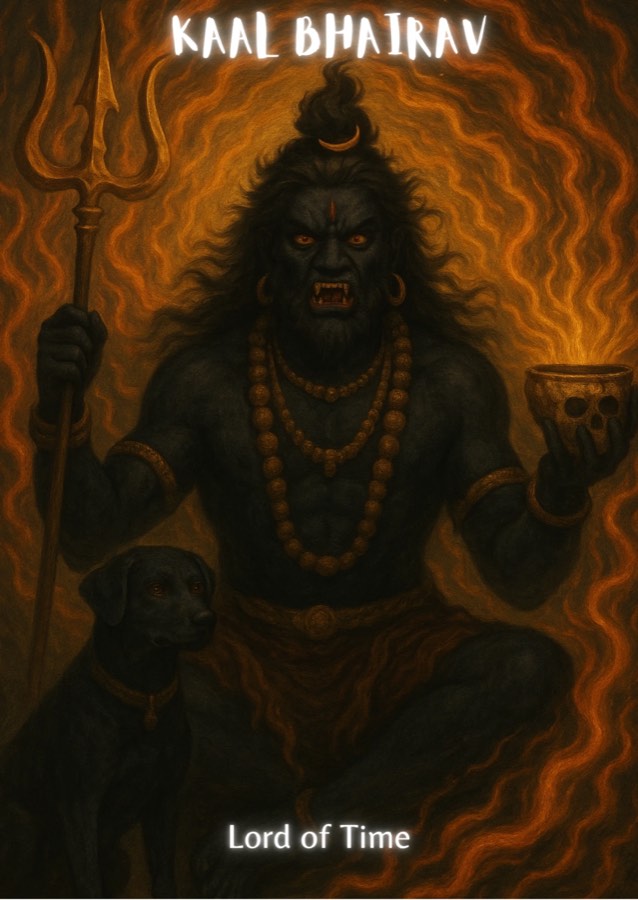
In the Puranic telling, Bhairava appears from Shiva to humble the pride of Brahma, the creator, and severs one of his five heads. The skull clings to Bhairava's hand as he wanders, until he reaches Kashi (Varanasi), where it finally falls away. Ever since, Kala Bhairava has been honoured as the guardian of Kashi. Pilgrims there still visit his temple to ask his blessing.
He is shown dark-bodied and sky-clad, with a trident, a garland of skulls and a dog as his companion. The images are fierce on purpose. They point to what cannot be bargained with: time, and the truth it eventually reveals.
About the hymn
- Name: Kālabhairavāṣṭakam (कालभैरवाष्टकम्), "eight verses to Kala Bhairava".
- Author: traditionally attributed to Adi Shankaracharya (8th century CE). The closing line names him. As with many hymns carrying his name, scholars cannot confirm the authorship.
- Structure: eight verses of praise, then a ninth verse describing the fruit of reciting it.
- Metre: pañcacāmara, sixteen syllables a line in a steady short-long beat (da-DUM da-DUM), the same metre as the Shiva Tandava Stotram. It is why the hymn feels like a drum.
- Refrain: every verse ends kāśikāpurādhinātha-kālabhairavaṃ bhaje: "I worship Kalabhairava, supreme lord of the city of Kashi."
How to read the verses
Each verse below has four layers. The Devanagari is the original script. The transliteration (IAST, the standard scholarly system) shows exactly how it sounds. Open How to say it for a simple phonetic version and Word by word for the meaning of each word. The translation follows the Sanskrit closely and adds nothing.
A quick guide to the phonetic lines: a double vowel is long (aa as in father, ee as in see, oo as in moon). e sounds as in day and o as in go. ri is a short, light r-sound. gy is how most Indian teachers pronounce jñ.
Verse 1
देवराजसेव्यमानपावनाङ्घ्रिपङ्कजं
व्यालयज्ञसूत्रमिन्दुशेखरं कृपाकरम् ।
नारदादियोगिवृन्दवन्दितं दिगम्बरं
काशिकापुराधिनाथकालभैरवं भजे ॥१॥
devarāja-sevyamāna-pāvanāṅghri-paṅkajaṃ
vyāla-yajñasūtram indu-śekharaṃ kṛpākaram
nāradādi-yogi-vṛnda-vanditaṃ digambaraṃ
kāśikāpurādhinātha-kālabhairavaṃ bhaje
How to say it
devaraaja-sevyamaana-paavanaanghri-pankajam
vyaala-yagyasootram indu-shekharam kripaakaram
naaradaadi-yogi-vrinda-vanditam digambaram
kaashikaapuraadhinaatha-kaalabhairavam bhaje
Word by word
- devarāja
- the king of the gods (Indra)
- sevyamāna
- being served by
- pāvana
- purifying
- aṅghri-paṅkaja
- lotus feet
- vyāla
- serpent
- yajñasūtra
- sacred thread
- indu-śekhara
- with the moon as his crest
- kṛpākara
- a mine of compassion
- nārada-ādi
- Narada and others
- yogi-vṛnda
- hosts of yogis
- vandita
- bowed to, praised
- digambara
- clothed in the directions: sky-clad
- kāśikā-pura
- the city of Kashi (Varanasi)
- adhinātha
- supreme lord
- kāla-bhairava
- Bhairava who is Time
- bhaje
- I worship, I take refuge in
TranslationHis purifying lotus feet are served by Indra, king of the gods. A serpent is his sacred thread, the moon is his crown, and he is a mine of compassion. Narada and the hosts of yogis bow to him, and he wears nothing but the sky. I worship Kalabhairava, supreme lord of the city of Kashi.
Verse 2
भानुकोटिभास्वरं भवाब्धितारकं परं
नीलकण्ठमीप्सितार्थदायकं त्रिलोचनम् ।
कालकालमम्बुजाक्षमक्षशूलमक्षरं
काशिकापुराधिनाथकालभैरवं भजे ॥२॥
bhānukoṭi-bhāsvaraṃ bhavābdhi-tārakaṃ paraṃ
nīlakaṇṭham īpsitārtha-dāyakaṃ trilocanam
kālakālam ambujākṣam akṣaśūlam akṣaraṃ
kāśikāpurādhinātha-kālabhairavaṃ bhaje
How to say it
bhaanukoti-bhaasvaram bhavaabdhi-taarakam param
neelakantham eepsitaartha-daayakam trilochanam
kaalakaalam ambujaaksham akshashoolam aksharam
kaashikaapuraadhinaatha-kaalabhairavam bhaje
Word by word
- bhānu-koṭi
- ten million suns
- bhāsvara
- shining
- bhava-abdhi
- the ocean of becoming (saṃsāra)
- tāraka
- one who carries across
- para
- supreme
- nīlakaṇṭha
- blue-throated
- īpsita-artha
- what is longed for
- dāyaka
- giver
- trilocana
- three-eyed
- kāla-kāla
- the Time of time, the death of Death
- ambuja-akṣa
- lotus-eyed
- akṣa-śūla
- bearer of the trident (akṣa may mean rudraksha beads or the world's axis; translators differ)
- akṣara
- imperishable
TranslationHe shines like ten million suns and carries us across the ocean of becoming; he is the Supreme. Blue-throated and three-eyed, he gives what the heart longs for. He is the death of Death, lotus-eyed, bearer of the trident, the imperishable. I worship Kalabhairava, supreme lord of the city of Kashi.
Verse 3
शूलटङ्कपाशदण्डपाणिमादिकारणं
श्यामकायमादिदेवमक्षरं निरामयम् ।
भीमविक्रमं प्रभुं विचित्रताण्डवप्रियं
काशिकापुराधिनाथकालभैरवं भजे ॥३॥
śūla-ṭaṅka-pāśa-daṇḍa-pāṇim ādikāraṇaṃ
śyāmakāyam ādidevam akṣaraṃ nirāmayam
bhīmavikramaṃ prabhuṃ vicitra-tāṇḍava-priyaṃ
kāśikāpurādhinātha-kālabhairavaṃ bhaje
How to say it
shoola-tanka-paasha-danda-paanim aadikaaranam
shyaamakaayam aadidevam aksharam niraamayam
bheemavikramam prabhum vichitra-taandava-priyam
kaashikaapuraadhinaatha-kaalabhairavam bhaje
Word by word
- śūla
- trident
- ṭaṅka
- axe
- pāśa
- noose
- daṇḍa
- staff
- pāṇi
- in his hands
- ādi-kāraṇa
- the first cause
- śyāma-kāya
- dark-bodied
- ādi-deva
- the primal god
- akṣara
- imperishable
- nirāmaya
- free of all affliction
- bhīma-vikrama
- of fearsome might
- prabhu
- the lord
- vicitra-tāṇḍava-priya
- who delights in the wondrous Tandava dance
TranslationTrident, axe, noose and staff are in his hands; he is the first cause. Dark of body, the primal god, imperishable, untouched by any affliction. He is the lord of fearsome might who delights in the wondrous Tandava dance. I worship Kalabhairava, supreme lord of the city of Kashi.
Verse 4
भुक्तिमुक्तिदायकं प्रशस्तचारुविग्रहं
भक्तवत्सलं स्थितं समस्तलोकविग्रहम् ।
विनिक्वणन्मनोज्ञहेमकिङ्किणीलसत्कटिं
काशिकापुराधिनाथकालभैरवं भजे ॥४॥
bhukti-mukti-dāyakaṃ praśasta-cāru-vigrahaṃ
bhaktavatsalaṃ sthitaṃ samasta-loka-vigraham
vinikvaṇan-manojña-hema-kiṅkiṇī-lasat-kaṭiṃ
kāśikāpurādhinātha-kālabhairavaṃ bhaje
How to say it
bhukti-mukti-daayakam prashasta-chaaru-vigraham
bhaktavatsalam sthitam samasta-loka-vigraham
vinikvanan-manogya-hema-kinkinee-lasat-katim
kaashikaapuraadhinaatha-kaalabhairavam bhaje
Word by word
- bhukti
- enjoyment of the world
- mukti
- liberation
- dāyaka
- giver
- praśasta-cāru-vigraha
- whose form is auspicious and beautiful
- bhakta-vatsala
- tender towards devotees
- sthita
- abiding (some editions read sthira, steady)
- samasta-loka-vigraha
- as the form of all the worlds
- vinikvaṇat
- jingling
- manojña
- charming
- hema-kiṅkiṇī
- little golden bells
- lasat-kaṭi
- whose waist gleams
TranslationHe gives both the joys of the world and liberation; his form is auspicious and beautiful. Tender towards his devotees, he abides as the form of all the worlds. At his waist, charming golden bells gleam and chime. I worship Kalabhairava, supreme lord of the city of Kashi.
Verse 5
धर्मसेतुपालकं त्वधर्ममार्गनाशकं
कर्मपाशमोचकं सुशर्मदायकं विभुम् ।
स्वर्णवर्णशेषपाशशोभिताङ्गमण्डलं
काशिकापुराधिनाथकालभैरवं भजे ॥५॥
dharma-setu-pālakaṃ tv adharma-mārga-nāśakaṃ
karma-pāśa-mocakaṃ suśarma-dāyakaṃ vibhum
svarṇa-varṇa-śeṣa-pāśa-śobhitāṅga-maṇḍalaṃ
kāśikāpurādhinātha-kālabhairavaṃ bhaje
How to say it
dharma-setu-paalakam tv adharma-maarga-naashakam
karma-paasha-mochakam susharma-daayakam vibhum
svarna-varna-shesha-paasha-shobhitaanga-mandalam
kaashikaapuraadhinaatha-kaalabhairavam bhaje
Word by word
- dharma-setu
- the bridge (or embankment) of dharma
- pālaka
- guardian
- tu
- and
- adharma-mārga
- the ways of adharma
- nāśaka
- destroyer
- karma-pāśa
- the noose of karma
- mocaka
- one who releases
- suśarma
- true well-being
- dāyaka
- giver
- vibhu
- all-pervading
- svarṇa-varṇa
- golden-hued
- śeṣa-pāśa
- serpent coils (Śeṣa, the cosmic serpent)
- śobhita
- adorned
- aṅga-maṇḍala
- the whole circle of his limbs
TranslationHe guards the bridge of dharma and destroys the ways of adharma. He releases us from the noose of karma and gives true well-being; he pervades everything. His whole body shines, wound with golden serpent coils. I worship Kalabhairava, supreme lord of the city of Kashi.
Verse 6
रत्नपादुकाप्रभाभिरामपादयुग्मकं
नित्यमद्वितीयमिष्टदैवतं निरञ्जनम् ।
मृत्युदर्पनाशनं करालदंष्ट्रमोक्षणं
काशिकापुराधिनाथकालभैरवं भजे ॥६॥
ratna-pādukā-prabhābhirāma-pāda-yugmakaṃ
nityam advitīyam iṣṭa-daivataṃ nirañjanam
mṛtyu-darpa-nāśanaṃ karāla-daṃṣṭra-mokṣaṇaṃ
kāśikāpurādhinātha-kālabhairavaṃ bhaje
How to say it
ratna-paadukaa-prabhaabhiraama-paada-yugmakam
nityam adviteeyam ishta-daivatam niranjanam
mrityu-darpa-naashanam karaala-damshtra-mokshanam
kaashikaapuraadhinaatha-kaalabhairavam bhaje
Word by word
- ratna-pādukā
- jewelled sandals
- prabhā
- radiance
- abhirāma
- lovely
- pāda-yugmaka
- pair of feet
- nitya
- eternal
- advitīya
- without a second
- iṣṭa-daivata
- the beloved deity
- nirañjana
- stainless
- mṛtyu-darpa
- the pride of Death
- nāśana
- destroyer
- karāla-daṃṣṭra
- fearsome fangs
- mokṣaṇa
- release (read either as fangs that bring release, or as release from the fangs of death)
TranslationHis two feet are lovely with the radiance of jewelled sandals. He is eternal, without a second, the beloved deity, stainless. He breaks the pride of Death, and his fearsome fangs bring release. I worship Kalabhairava, supreme lord of the city of Kashi.
Verse 7
अट्टहासभिन्नपद्मजाण्डकोशसन्ततिं
दृष्टिपातनष्टपापजालमुग्रशासनम् ।
अष्टसिद्धिदायकं कपालमालिकाधरं
काशिकापुराधिनाथकालभैरवं भजे ॥७॥
aṭṭahāsa-bhinna-padmajāṇḍa-kośa-santatiṃ
dṛṣṭipāta-naṣṭa-pāpa-jālam ugra-śāsanam
aṣṭasiddhi-dāyakaṃ kapāla-mālikā-dharaṃ
kāśikāpurādhinātha-kālabhairavaṃ bhaje
How to say it
attahaasa-bhinna-padmajaanda-kosha-santatim
drishtipaata-nashta-paapa-jaalam ugra-shaasanam
ashtasiddhi-daayakam kapaala-maalikaa-dharam
kaashikaapuraadhinaatha-kaalabhairavam bhaje
Word by word
- aṭṭahāsa
- thunderous laughter
- bhinna
- shattered
- padmaja
- the lotus-born (Brahma, the creator)
- aṇḍa-kośa
- the cosmic eggs: universes
- santati
- the whole succession
- dṛṣṭi-pāta
- the fall of his glance
- naṣṭa
- destroyed
- pāpa-jāla
- the net of sin
- ugra-śāsana
- whose rule is stern
- aṣṭa-siddhi
- the eight siddhis (subtle powers)
- dāyaka
- giver
- kapāla-mālikā
- garland of skulls
- dhara
- wearing
TranslationHis thunderous laugh shatters the whole succession of cosmic eggs born of the lotus-born Creator. A single glance destroys the net of sin, and his rule is stern. He gives the eight siddhis and wears a garland of skulls. I worship Kalabhairava, supreme lord of the city of Kashi.
Verse 8
भूतसङ्घनायकं विशालकीर्तिदायकं
काशिवासलोकपुण्यपापशोधकं विभुम् ।
नीतिमार्गकोविदं पुरातनं जगत्पतिं
काशिकापुराधिनाथकालभैरवं भजे ॥८॥
bhūtasaṅgha-nāyakaṃ viśāla-kīrti-dāyakaṃ
kāśivāsa-loka-puṇya-pāpa-śodhakaṃ vibhum
nīti-mārga-kovidaṃ purātanaṃ jagatpatiṃ
kāśikāpurādhinātha-kālabhairavaṃ bhaje
How to say it
bhootasangha-naayakam vishaala-keerti-daayakam
kaashivaasa-loka-punya-paapa-shodhakam vibhum
neeti-maarga-kovidam puraatanam jagatpatim
kaashikaapuraadhinaatha-kaalabhairavam bhaje
Word by word
- bhūta-saṅgha
- the hosts of spirits and beings
- nāyaka
- leader
- viśāla-kīrti
- vast renown
- dāyaka
- giver
- kāśi-vāsa-loka
- the people who dwell in Kashi
- puṇya-pāpa
- merit and sin
- śodhaka
- one who purifies, settles the account of
- vibhu
- all-pervading
- nīti-mārga
- the path of right conduct
- kovida
- wise in
- purātana
- the ancient one
- jagat-pati
- lord of the universe
TranslationHe leads the hosts of spirits and gives far-reaching renown. All-pervading, he settles the merit and sin of everyone who dwells in Kashi. Wise in the path of right conduct, he is the ancient one, lord of the universe. I worship Kalabhairava, supreme lord of the city of Kashi.
Verse 9 · The fruit of reciting (phalaśruti)
कालभैरवाष्टकं पठन्ति ये मनोहरं
ज्ञानमुक्तिसाधनं विचित्रपुण्यवर्धनम् ।
शोकमोहदैन्यलोभकोपतापनाशनं
प्रयान्ति कालभैरवाङ्घ्रिसन्निधिं नरा ध्रुवम् ॥९॥
kālabhairavāṣṭakaṃ paṭhanti ye manoharaṃ
jñāna-mukti-sādhanaṃ vicitra-puṇya-vardhanam
śoka-moha-dainya-lobha-kopa-tāpa-nāśanaṃ
prayānti kālabhairavāṅghri-sannidhiṃ narā dhruvam
How to say it
kaalabhairavaashtakam pathanti ye manoharam
gyaana-mukti-saadhanam vichitra-punya-vardhanam
shoka-moha-dainya-lobha-kopa-taapa-naashanam
prayaanti kaalabhairavaanghri-sannidhim naraa dhruvam
Word by word
- kālabhairava-aṣṭaka
- these eight verses to Kalabhairava
- paṭhanti ye
- those who recite
- manohara
- lovely, captivating the mind
- jñāna-mukti-sādhana
- a means to knowledge and liberation
- vicitra-puṇya-vardhana
- increasing merit of every kind
- śoka
- grief
- moha
- delusion
- dainya
- misery, wretchedness
- lobha
- greed
- kopa
- anger
- tāpa
- torment, burning
- nāśana
- destroying
- prayānti
- reach
- aṅghri-sannidhi
- the presence of his feet
- narāḥ
- people
- dhruvam
- surely
TranslationThose who recite this lovely Kalabhairava Ashtakam, a means to knowledge and liberation that increases merit of every kind and destroys grief, delusion, misery, greed, anger and torment, surely reach the presence of Kalabhairava's feet.
Closing line (colophon)
इति श्रीमच्छङ्कराचार्यविरचितं कालभैरवाष्टकं सम्पूर्णम् ॥
iti śrīmacchaṅkarācāryaviracitaṃ kālabhairavāṣṭakaṃ sampūrṇam
TranslationThus ends the Kalabhairava Ashtakam composed by the revered Shankaracharya.
My reflection: the Lord of Time and the reel
This section is my own reading, not part of the hymn.
In the Projector Theory, your life is light passing through a reel of imprints, the samskaras, and appearing on the screen as your days. Look closely at that reel and you'll find it is made of time. A samskara is a past moment that never finished. It keeps playing in the present, so the old scene keeps showing up in new places.
The hymn calls Bhairava kālakāla, the Time of time, the death of Death. He is not inside the film. He is the light the film runs through. Time can end every scene, but it cannot touch the light that shows them.
The Vijnana Bhairava Tantra, the text much of my meditation teaching draws on, is a dialogue in which Bhairava offers the Goddess 112 ways to rest as that light. Commentators in the Kashmir Shaiva tradition read the three syllables of his name as three movements: bha for bharaṇa, sustaining; ra for ravaṇa, withdrawing; and va for vamana, projecting. To me that is the projector itself: it casts the movie, holds it on the screen, and draws it back into the light.
So when the fifth verse praises him as karma-pāśa-mocaka, the one who frees us from the noose of karma, I hear an invitation, not a promise. Every time you rest as the witness behind the scene, the reel loses a little of its grip.
How it can help
There are three ways to look at what this hymn offers: what the text itself says, how the tradition uses it, and what the practice of chanting does in the body and mind.
What the hymn says
The ninth verse names its own fruit. It calls the hymn jñāna-mukti-sādhana, a means to knowledge and liberation, and says it destroys śoka (grief), moha (delusion), dainya (misery), lobha (greed), kopa (anger) and tāpa (inner burning). Those are the hymn's words, offered in faith, not a guarantee. Look at the list closely, though. Every item on it is a samskara on the reel.
How the tradition uses it
- For courage and protection. Bhairava is the guardian of Kashi, and devotees chant to him when they feel afraid, unprotected or about to begin something new, including a journey.
- For discipline with time. As the Lord of Time, he is invoked when life feels delayed or stuck, or when procrastination keeps winning.
- On Kalashtami and in hard seasons. Many devotees chant on the eighth day of the waning moon. Some astrologers also suggest Bhairava worship during difficult Saturn periods, which in my own work is when old imprints tend to surface.
- For letting things end. Kala is the one who ends every form. The hymn is a natural companion when a relationship, a role or a version of yourself is finishing.
What the practice itself does
Chanting a steady, rhythmic text slows and lengthens the breath and gathers scattered attention into one channel. For many people that supports a calmer, more focused state. That is the same principle behind mantra in the Vijnana Bhairava Tantra. The meaning matters too. When you know you are saying "the one who frees us from the noose of karma", the words become an intention you can feel, not just sounds.
Chanting is a spiritual and reflective practice. It may support calm and focus, but it is not medical or psychological treatment. If fear, grief or anger feels overwhelming, please also reach out to a qualified professional.
How to chant it
- Sit comfortably with your spine upright. Take three slow breaths.
- Begin slowly. Let the short-long beat carry you: da-DUM, da-DUM.
- If the full verses feel like too much at first, chant only the refrain, kāśikāpurādhinātha-kālabhairavaṃ bhaje, nine times.
- When you finish, don't get up. Sit in the silence the sound leaves behind for a minute. That silence is part of the practice.
A 21-day practice: chant the full hymn once each morning, or the refrain nine times, at the same time each day. Afterwards, write one line about what you noticed: a fear, a delay, something ready to end. Patterns become visible when you look at them daily.
Many chant the hymn on Kalashtami, the eighth day of the waning moon each month. Any day works. What matters is the attention you bring to it.
Frequently asked
Who wrote the Kala Bhairava Ashtakam?
Tradition attributes it to Adi Shankaracharya, the 8th-century philosopher, and the closing line of the hymn names him. Many hymns carry his name and scholars cannot confirm the authorship of each one, so the honest answer is: traditionally attributed to Adi Shankaracharya.
What does Kala Bhairava mean?
Kāla means time, and also death, since time is what ends every form. Bhairava is the fierce form of Shiva, the one who is beyond fear. Kala Bhairava is Shiva as the Lord of Time, the awareness in which time itself appears and dissolves.
What does the refrain kāśikāpurādhinātha-kālabhairavaṃ bhaje mean?
"I worship Kalabhairava, supreme lord of the city of Kashi." Kashi is Varanasi, where Kala Bhairava is honoured as the guardian of the city.
What are the benefits of chanting the Kala Bhairava Ashtakam?
The hymn's ninth verse says it is a means to knowledge and liberation and that it removes grief, delusion, misery, greed, anger and inner burning. Traditionally it is chanted for courage, protection and discipline with time. As a practice, rhythmic chanting slows the breath and focuses attention, which many people find calming. It is a spiritual practice, not a guaranteed outcome or a medical treatment.
When is the Kala Bhairava Ashtakam chanted?
It can be chanted any day. It is traditionally chanted on Kalashtami, the eighth day of the waning moon each month, and especially on Kalabhairava Jayanti, the day honouring his appearance.
Do I need initiation to chant it?
Stotras like this one are hymns of praise and are traditionally chanted openly by anyone with respect. If you follow a particular lineage or teacher, follow their guidance.
Is this a word-for-word translation?
Each verse has a word-by-word breakdown and a faithful line-by-line translation. Where a compound can be read more than one way, the word notes show the other reading instead of hiding it.
Sources and a note on accuracy
The Sanskrit follows the standard text attributed to Adi Shankaracharya. I checked it word by word against a published edition, and the only differences were in how nasal sounds are spelled (ं or ङ्/ञ्/न्/म्), which sound the same. Other editions carry small variant readings, such as sthiraṃ for sthitaṃ in verse 4; the word notes flag the ones that change the meaning. Word meanings follow the Monier-Williams Sanskrit-English Dictionary. If you spot an error, please tell me and I'll correct it.
- Kalabhairava Ashtakam, text and notes: greenmesg.org and shlokam.org
- Monier Monier-Williams, A Sanskrit-English Dictionary (Oxford, 1899)
- Jaideva Singh, Vijñānabhairava or Divine Consciousness (Motilal Banarsidass, 1979)
- Kalabhairavashtakam, Wikipedia overview
Rest as the light
Time ends every scene. It has never touched the light that shows them.
Meditation coaching
The journey to Self-Realisation: mantra, the space within the breath and the Vijnana Bhairava Tantra, one step at a time.
Begin the journeyThe next Timeless Teaching
Every new teaching, a short practice and the free weekly reading, by email or WhatsApp. One click unsubscribes.
Join the listTimeless Teachings shares sacred texts for study and personal practice, with respect for the traditions they come from. Meditation and mantra practice support reflection and wellbeing; they are not medical or psychological treatment and do not replace professional care.